Free shipping over CA$140
How many nicotine pouches per day?
Any directions on the can come first. Beyond that, the count itself is the wrong metric - what your body experiences is total milligrams of nicotine, and that depends on the strength of each pouch, not just how many you use.
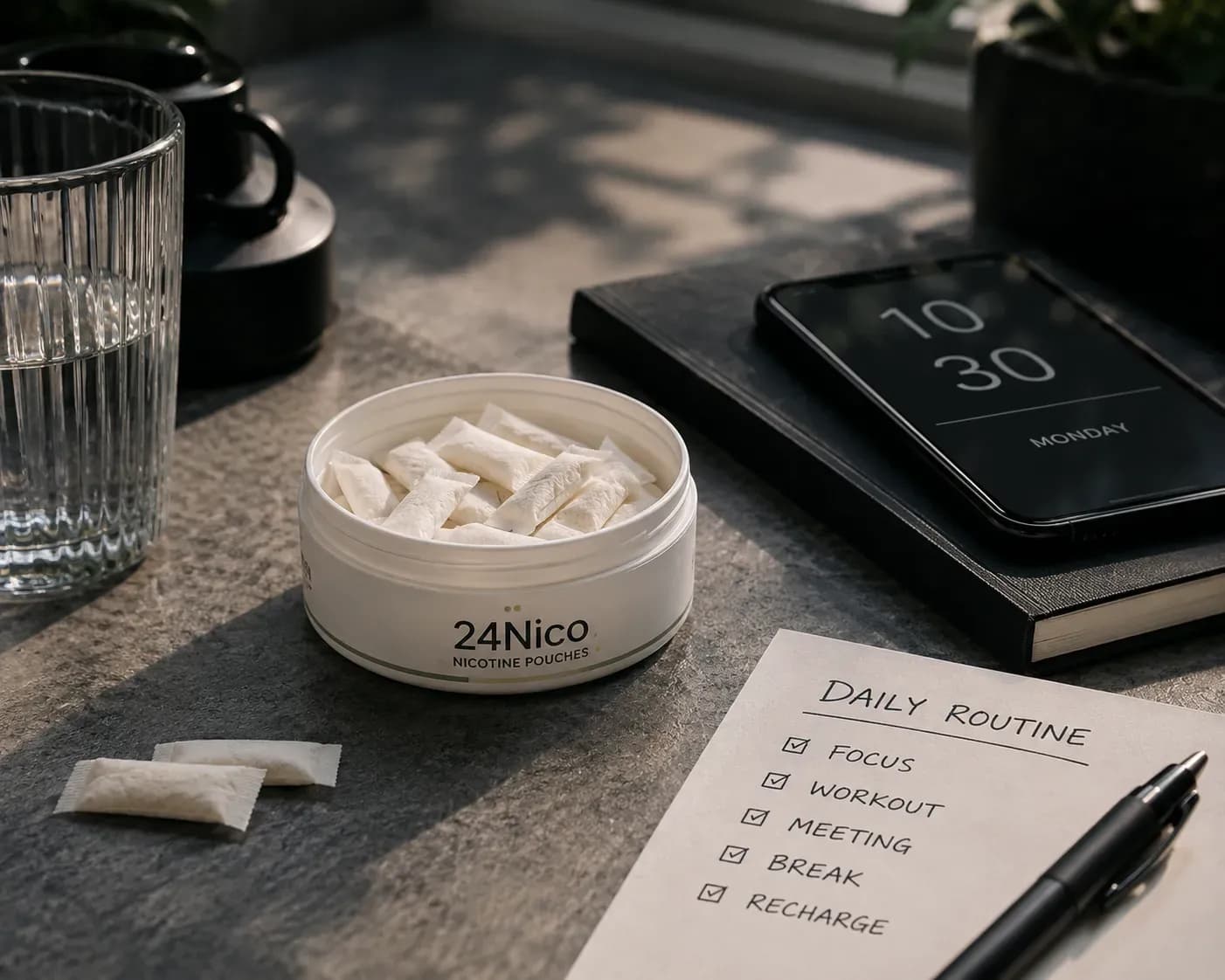
How many nicotine pouches per day? The short answer
Any directions on the can come first, and beyond that the count itself is the wrong metric. What your body experiences is total milligrams of nicotine, which depends on the strength of each pouch, not just how many you use.
Why "milligrams per day" matters more than "pouches per day"
A pouch count tells you nothing about how much nicotine you actually absorbed. Two users with the same pouch count can have very different daily intakes:
- User A uses 10 pouches a day at 2 mg per pouch → 20 milligrams of nicotine in the pouches.
- User B uses 10 pouches a day at 4 mg per pouch → 40 milligrams in the pouches.
Same count, twice the nicotine for User B.
You don't absorb 100% of the nicotine in a pouch - bioavailability depends on the product, your saliva and how long you keep the pouch in. But the labelled mg-per-pouch is the right number to use for tracking, because it's the only one that's consistent and comparable across products. If your goal is to understand your usage, track the labelled milligrams.
A simple calculation: working out your daily nicotine intake
Three steps:
- Find the strength of the pouch you use in mg per pouch - it's printed on the can. (If your can shows mg per gram instead, see how the two figures relate in our strength guide).
- Count the pouches you use in a typical day. Round up rather than down - be honest.
- Multiply. Strength × count = your daily nicotine in milligrams.
A worked example: 7 pouches a day at 2 mg per pouch = 14 milligrams of labelled nicotine per day. If you switch to 3 mg pouches and keep the same count, you've moved to 21 milligrams - a 50% increase, even though the pouch count looks identical.
Strength × usage table
The table below uses strengths from the Canadian range, plus nicotine-free pouches, to show what different daily counts add up to in milligrams of nicotine.
Strength per pouch: Nicotine-free 5 pouches/day (milligrams): 0 10 pouches/day (milligrams): 0 15 pouches/day (milligrams): 0 |
Strength per pouch: 1.5 mg 5 pouches/day (milligrams): 7.5 10 pouches/day (milligrams): 15 15 pouches/day (milligrams): 22.5 |
Strength per pouch: 2 mg 5 pouches/day (milligrams): 10 10 pouches/day (milligrams): 20 15 pouches/day (milligrams): 30 |
Strength per pouch: 3 mg 5 pouches/day (milligrams): 15 10 pouches/day (milligrams): 30 15 pouches/day (milligrams): 45 |
Strength per pouch: 4 mg 5 pouches/day (milligrams): 20 10 pouches/day (milligrams): 40 15 pouches/day (milligrams): 60 |
A few things to notice:
- The same pouch count looks completely different across strengths. Ten pouches a day at 2 mg (20 milligrams) is very different from ten at 4 mg (40 milligrams).
- Strength and count multiply. Five pouches a day at 4 mg is the same total as ten a day at 2 mg: 20 milligrams.
- If you change strength, recheck your total. A user at 10 a day on 3 mg pouches is at 30 milligrams. On 4 mg pouches, the same 30 milligrams is 7 to 8 pouches a day, not 10.
For full context on strengths, see our strength guide.
Three levers if you want to bring your daily total down
The body signals that suggest a daily count or strength has crept up too far (dizziness, racing pulse, nausea, disrupted sleep, sore gums) are covered in detail in our side effects guide. If any of those match how you've been feeling, three practical levers reduce daily milligrams:
- Drop the strength and keep the count the same. From 3 mg to 2 mg per pouch is a ~33% reduction in daily nicotine without changing your routine. The strength lever is the biggest one.
- Hold the strength and trim the count by 1–2 a day. Slower, but useful if you've already found a strength you're comfortable with.
- Move to a slimmer or drier format. Slim and dry formats release more slowly, so a single pouch tends to last longer - some users naturally reach for fewer per day when each one stays in for 30+ minutes.
This is a user choice, not a quit-smoking pathway. If you want to stop using nicotine entirely, speak to a health care professional.
FAQ
How many nicotine pouches per day is normal?
There is no single normal number. It depends on the person and on the strength of the pouch, and any directions on the can come first. Counting milligrams per day tells you more than counting pouches.
How many nicotine pouches per day is too many?
Too many is more than any directions on the can allow, or more than your own tolerance. Most users describe symptoms like dizziness, nausea, a fast heartbeat or trouble sleeping when they've gone past their tolerance - those signals are the practical "too many" line for most people, regardless of count.
Can you use more than one pouch at a time?
Manufacturers don't recommend it. Two pouches at once doubles your nicotine exposure for that session and is the fastest route to overdoing it. Use one pouch at a time.
Does pouch strength change how many I use per day?
It can - and that's exactly why the count alone is misleading. Ten pouches a day at 2 mg and five a day at 4 mg add up to the same 20 milligrams. Compare daily totals, not counts.