Free shipping over $99
Energy pouches vs energy drinks vs coffee
"Energy pouches" is the name a lot of shoppers use for caffeine pouches: a small white pouch placed under the upper lip, with caffeine listed on the panel and no nicotine. Most people already get their caffeine from an energy drink or a cup of coffee.
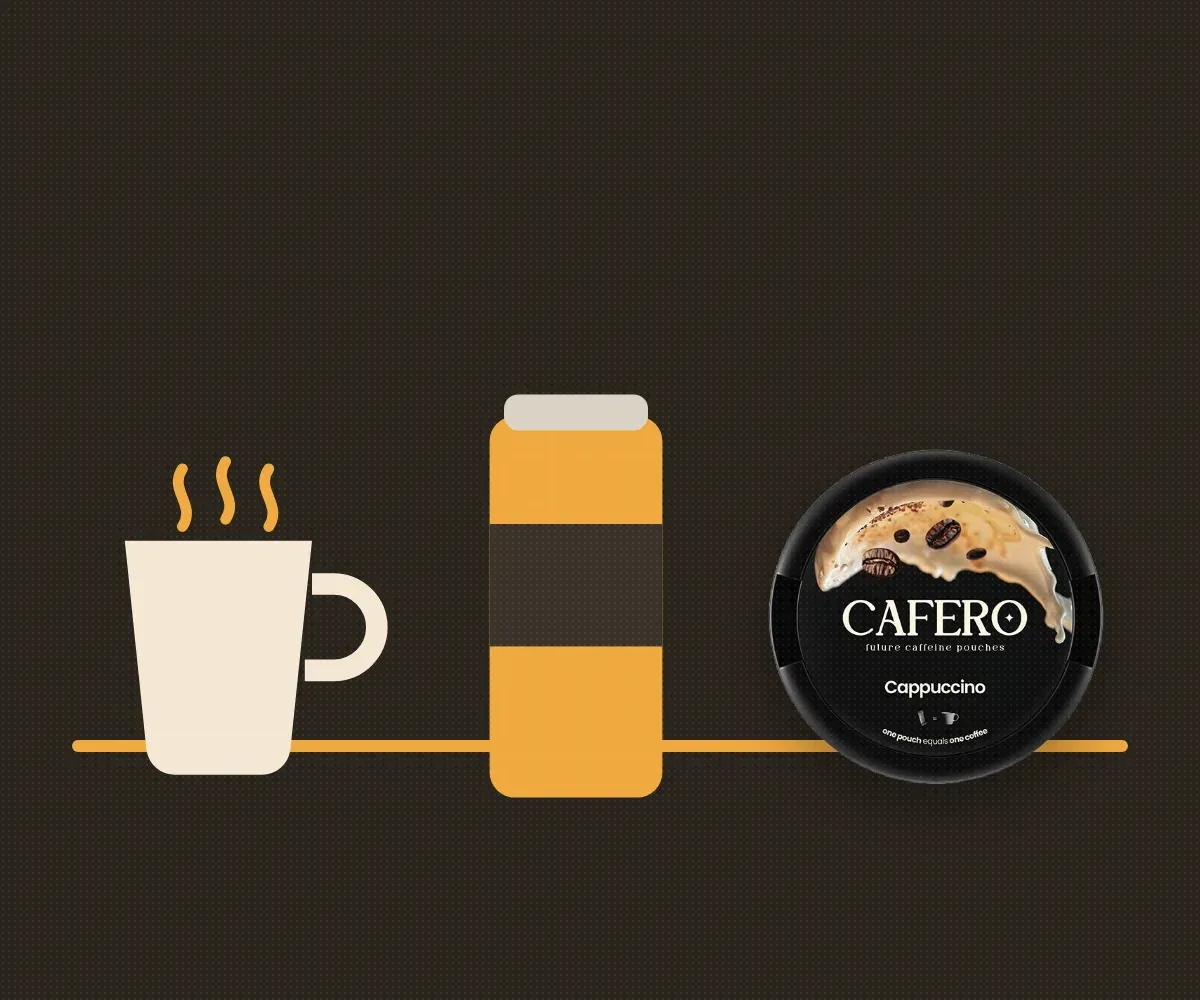
All three contain caffeine. The difference is the form it comes in.
A caffeine pouch is a dry, pre-portioned pouch. The base is plant fiber (E460, microcrystalline cellulose), with water, salt, flavorings, sweeteners and a measured amount of caffeine. You place it under your upper lip and leave it there. Nothing is swallowed, nothing is drunk. In our assortment every caffeine pouch is Slim format, white, and weighs between 0.6 g and 0.75 g.
An energy drink is a carbonated beverage in a can. Caffeine is one ingredient among many; the rest is typically water, sugar or sweeteners, acids, flavorings and often taurine and B vitamins. You drink it.
Brewed coffee is a hot drink made by passing water through ground roasted coffee beans. Caffeine occurs naturally in the bean; nothing is added unless you add it. You drink it too.
The pouch is the odd one out: it's the only one of the three that isn't a liquid.
Caffeine per serving
For pouches, the figure is what the manufacturer prints on the can, per pouch, and what our product pages quote. The beverage figures come from Red Bull for its 250 ml can and from USDA FoodData Central for a cup of brewed coffee.
Serving: LEWA BURN, FOCUS, GLOW (one pouch) Caffeine: 20 mg Sugar: None; sweeteners Volume or weight: 0.6 g pouch Source: Manufacturer panel |
Serving: LEWA POWER (one pouch) Caffeine: 50 mg Sugar: None; sweeteners Volume or weight: 0.6 g pouch Source: Manufacturer panel |
Serving: CAMO Bubble Gum, Vanilla Coffee, Iced Mocha (one pouch) Caffeine: 77 mg Sugar: None; sweetener Volume or weight: 0.75 g pouch Source: Manufacturer panel |
Serving: CAFERO Americano, Cappuccino, Vanilla Latte (one pouch) Caffeine: 80 mg Sugar: None; sweetener E955 Volume or weight: 0.65 g pouch Source: Manufacturer panel |
Serving: Hicaff Classic Cola, Energy Rush, Fresh Mint (one pouch) Caffeine: 100 mg Sugar: None; sweeteners Volume or weight: 0.7 g pouch Source: Manufacturer panel |
Serving: Red Bull, one can Caffeine: 80 mg Sugar: Stated on the can's nutrition label Volume or weight: 250 ml Source: Red Bull (manufacturer) |
Serving: Brewed coffee, one cup Caffeine: About 95 mg Sugar: None unless added Volume or weight: 8 oz cup (about 240 ml) Source: USDA FoodData Central |
The pouches we sell span 20 mg to 100 mg per pouch. A 250 ml can of Red Bull sits at 80 mg, which is the same number CAFERO prints on its can. A cup of brewed coffee is commonly cited at about 95 mg, between CAFERO and Hicaff. The lightest pouches, at 20 mg, are a quarter of a Red Bull.
First, a pouch is one serving by design; a can is one serving by design; a cup of coffee is whatever size the cup is, and the USDA figure is for 8 oz. Second, these are label figures, not measurements of what reaches you, which varies by product and by person. Caffeine is a stimulant; how you respond to it is individual.
Sugar and sweeteners
None of the caffeine pouches in our assortment contain sugar. Sweetness comes from sweeteners, named on each panel:
LEWA BURN Citrus Mint: E968 (erythritol), E950 (acesulfame K), E960 (stevia), E955 (sucralose) |
LEWA FOCUS Cucumber Mint: erythritol, Ace-K, stevia (RA97), sucralose |
LEWA GLOW Strawberry Vanilla: E968 (erythritol), E958 (glycyrrhizin), E960 (stevia), E955 (sucralose) |
LEWA POWER (four flavors): erythritol, Ace-K, stevia (RA97), sucralose |
CAFERO Americano, Cappuccino, Vanilla Latte: E955 (sucralose) |
CAMO Bubble Gum, Vanilla Coffee, Iced Mocha: "Sweetener" (not specified on the panel) |
Hicaff Classic Cola Slim, Energy Rush Slim: E955 (sucralose) |
Hicaff Fresh Mint Slim: E955 (sucralose), E950 (acesulfame K), E967 (xylitol) |
Those E-numbers are a regulatory shorthand, not a warning. E955 is sucralose, E950 is acesulfame K, E967 is xylitol (also known as birch sugar), E960 is stevia, E968 is erythritol and E958 is glycyrrhizin, a sweetener from licorice root. All are common across the food industry. The ingredients guide goes through every E-number in the range.
Energy drinks are a different story. The standard version of most energy drinks is sweetened with sugar; the amount is printed on the can's nutrition label and differs by brand and by version. Sugar-free versions use sweeteners instead, much like the pouches do.
Brewed coffee contains no sugar unless you add it, and no sweeteners unless you add those.
Volume, weight and what's left over
A caffeine pouch is small. The heaviest in our range is CAMO at 0.75 g per pouch; the lightest is LEWA at 0.6 g. A full can is 18 or 20 pouches and weighs between 10.8 g (LEWA, 18 pouches) and 15 g (CAMO, 20 pouches) net. The can itself fits in a pocket.
A can of Red Bull is 250 ml. A cup of brewed coffee is whatever you pour, with the USDA reference at 8 oz.
What's left afterward is different too. A used pouch is a small damp pouch to throw away; most cans have a compartment in the lid for exactly that. A drink leaves a can or a cup.
Where each one is used
The form decides the setting.
A pouch is used anywhere you can keep something under your lip for a while and don't want, or can't have, a drink in your hand. It makes no noise, needs no cup, no fridge and no machine, and you can talk with one in. Because nothing is swallowed, there's nothing to spill.
An energy drink is used where a cold can is practical: it needs to be bought chilled or kept chilled, opened and finished. It's the usual choice when you also want something to drink.
Coffee needs hot water and equipment, or a café. It's a drink first and a caffeine source second, and for many people it's part of a routine around meals and mornings.
How long a pouch is kept in
With a drink, "how long" isn't a question; it's done when the can or cup is empty. With a pouch it's a real question, because the pouch stays in place and releases flavor and caffeine over time rather than all at once.
Manufacturers differ, and the can states the recommended time. The general pattern is the same across brands. Place the pouch under your upper lip, leave it until the flavor fades, then remove it and throw it away. Don't chew it and don't swallow it. One pouch is one serving.
If you've used nicotine pouches or Swedish snus, the mechanics are the same format with a different, nicotine-free content. If you haven't, the caffeine pouches guide walks through the first use step by step.
What the label tells you
In the US, caffeine pouches are sold as dietary supplements or foods under FDA rules. The ingredients panel and a supplement-facts style label stating the caffeine per pouch are what the law expects on the can. Rules can change; the can in your hand is what applies.
The one figure worth checking across all three forms is caffeine per serving, because it's the only one you can line up directly. For reference, the FDA's consumer guidance ("Spilling the Beans") says up to 400 mg of caffeine a day is not generally associated with negative effects for healthy adults. EFSA's 2015 scientific opinion gives 400 mg a day and 200 mg in a single serving for healthy adults. ACOG and the NHS cite 200 mg a day during pregnancy, and the AAP discourages caffeine for children and adolescents.
Any exclusions the manufacturer makes are printed on the can.
Where to find them
Every caffeine pouch here is in the nicotine-free range, filtered under caffeine pouches. By brand: Hicaff for the 100 mg pouches, CAFERO for the coffee-flavored 80 mg line, CAMO at 77 mg, and LEWA for the 20 mg and 50 mg pouches. All taxes and import fees are included in the price you see, nothing extra on delivery; see shipping for how orders reach the US.
The ingredients panel on each can is the source of truth.
FAQ
What are energy pouches?
Another name for caffeine pouches: small nicotine-free pouches placed under the upper lip with a stated amount of caffeine per pouch. In our assortment they contain 20 mg to 100 mg of caffeine each, printed on the can.
How much caffeine is in an energy pouch compared with an energy drink?
It depends on the pouch. The pouches we sell range from 20 mg (LEWA BURN, FOCUS, GLOW) to 100 mg (Hicaff) per pouch; a 250 ml can of Red Bull contains 80 mg according to the manufacturer. CAFERO's 80 mg per pouch matches the can exactly.
How does a caffeine pouch compare with a cup of coffee?
An 8 oz cup of brewed coffee is commonly cited at about 95 mg of caffeine by USDA FoodData Central. That puts it between CAFERO (80 mg) and Hicaff (100 mg) per pouch, and well above the 20 mg LEWA pouches.
Do caffeine pouches contain sugar?
No. Every caffeine pouch in our range is sweetened with sweeteners such as sucralose (E955), acesulfame K (E950), xylitol (E967), stevia (E960) or erythritol, as named on each panel. Energy drinks typically contain sugar in their standard version; the can states how much.
How long do you keep an energy pouch in?
The can states the recommended time, and it differs between manufacturers. The general rule is to leave the pouch under your upper lip until the flavor fades, then remove it and throw it away.
Do you swallow an energy pouch?
No. The pouch stays under your upper lip and is removed and thrown away afterward. Nothing is chewed or swallowed.
Are energy pouches the same as nicotine pouches?
No. They share the format, a white Slim pouch under the lip, but every pouch in our nicotine-free range contains 0 mg nicotine and no tobacco. The active ingredient is caffeine.