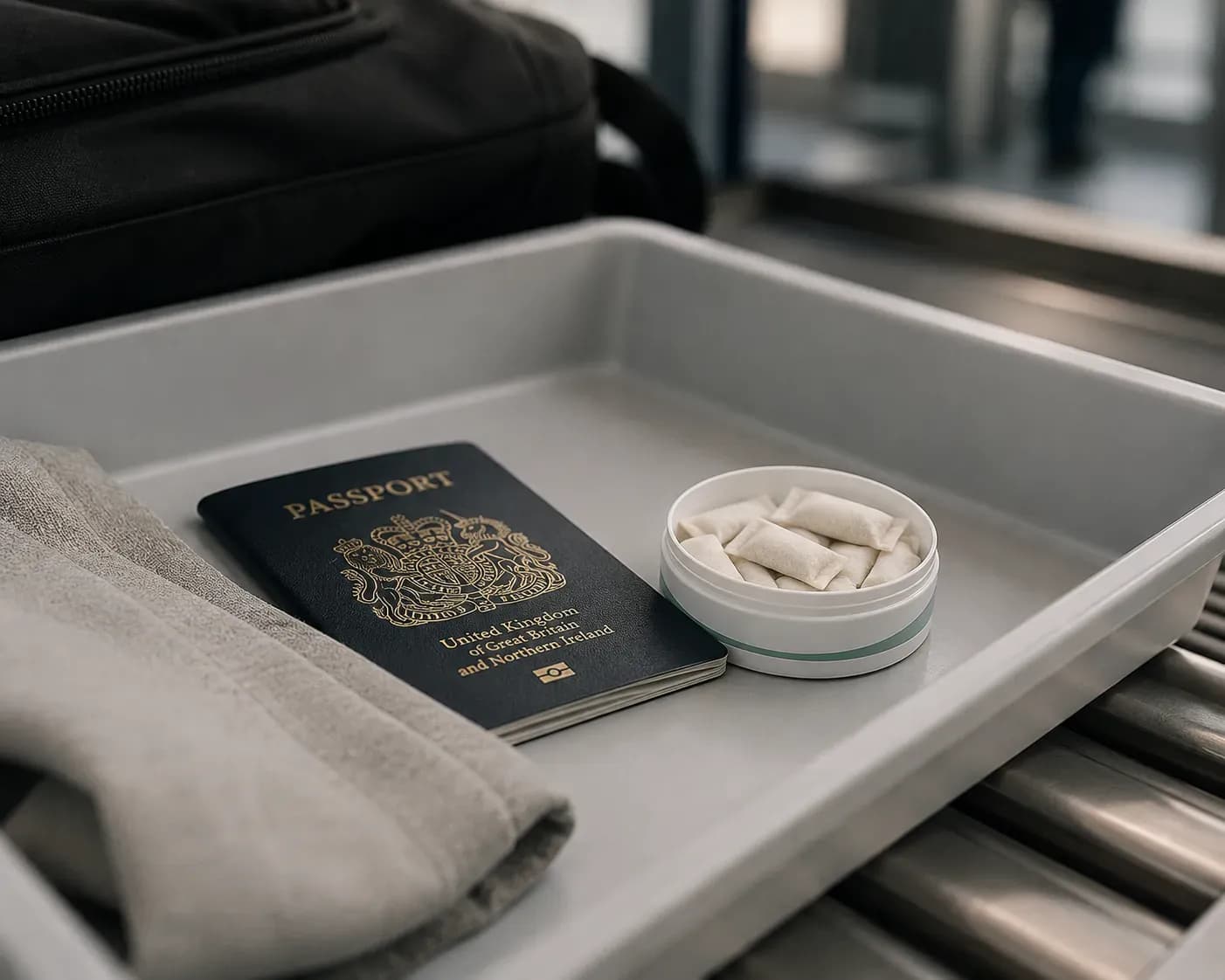
The general rule across UK aviation: if it isn't a liquid over 100 ml, a battery the airline restricts, a sharp object, or on the prohibited-items list published by the UK Civil Aviation Authority, it goes through. Nicotine pouches don't appear on any of those lists.
If you're flying with a smaller carrier or a charter, it's worth a quick check on their dangerous-goods page - but in our experience, no UK-licensed passenger airline currently treats nicotine pouches as restricted.
Countries where you should not land with nicotine pouches
This is where travellers get caught out. The UK and most of the EU treat nicotine pouches as an ordinary consumer product. Some countries don't.
The list below is current as of May 2026 and should be re-checked before any trip - regulation in this category moves quickly, and customs enforcement varies even within a country.
Confirmed restrictions or bans:
- France. From 1 April 2026, France has banned the use, acquisition, possession, sale and import of nicotine pouches under a national decree. Do not pack pouches for France - possession alone is now an offence.
- Australia. Nicotine pouches are treated as unapproved therapeutic goods - none have been approved by the TGA for sale in Australia. Personal import requires a valid prescription from an Australian-registered medical practitioner under the Personal Importation Scheme. Imports that don't meet these conditions can be seized and destroyed.
- Singapore. Nicotine pouches are classified as prohibited "imitation tobacco products" under the Tobacco and Vaporisers Control Act. The Immigration and Checkpoints Authority seizes illegal imports at the border. Don't pack them for Singapore.
- Thailand. Thailand's Public Health Ministry classifies nicotine pouches (including white pouches and snus) as tobacco products under the Tobacco Products Control Act 2017. Display, promotion and online sale are banned, and online sale was further restricted in 2025. Carrying pouches into Thailand carries real risk of confiscation.
- United Arab Emirates. Nicotine pouches are now formally regulated under standard UAE.S FDS 5061:2024 (effective July 2025), which requires pharmaceutical-grade nicotine, child-resistant packaging and labelling in Arabic and English. Personal-use quantities of compliant products are generally tolerated, but unmarked or unbranded pouches risk confiscation. Declare on arrival if asked.
- India. Several Indian states restrict or ban nicotine pouches under smokeless-tobacco laws, and Tamil Nadu's Directorate of Drugs Control has issued public alerts against sale or use. Regulatory enforcement is uneven; safest assumption is that pouches are not legal for personal import.
Caution / grey area:
- Belgium banned the retail sale of nicotine pouches in 2023. Personal-use import is a grey area.
- Luxembourg followed with a sales ban in 2024.
- The Netherlands banned retail sales from January 2025.
- Japan classifies tobacco-free nicotine pouches as pharmaceutical products under the Pharmaceutical and Medical Device Act. Personal import for own use is permitted, but sale requires a pharmaceutical licence - pouches are not in convenience stores. Bringing a personal-use supply is legal; reselling is not.
Generally fine for personal use (subject to declared quantities): most of the EU/EEA outside the four countries listed above, the United States, Canada, most of Latin America, South Africa, New Zealand (in small personal quantities - check current rules).
The safest rule: if you're flying anywhere outside the UK, EU, or North America, check the destination country's customs authority website 48 hours before flying. A short search of "[country name] nicotine pouches customs" will usually surface the current position.
Quantity limits and customs declarations
Within the UK and EU, there's no specific quantity limit on nicotine pouches for personal use. They're not subject to UK tobacco duty (because they don't contain tobacco), so the duty-free tobacco allowance doesn't apply.
For long-haul travel, a sensible upper limit for "personal use" is **around 10 cans (200 pouches)** - enough for a two-to-three-week trip at typical use. Larger quantities can attract attention at customs, even in countries where pouches are legal, because volume starts to look commercial rather than personal.
Customs declaration tips:
- Keep cans in original packaging.
- Don't split pouches into bags or unmarked containers - this looks suspicious and may trigger questioning.
- If a customs form asks about "tobacco products", nicotine pouches are not tobacco. If it asks about "nicotine products" specifically, declare them.
- Some travellers carry a printout of the product page from a UK retailer (showing the pouches are tobacco-free) as backup. Worth doing for destinations with stricter regimes.
Storage tips for long-haul flights
Cabin air is dry - relative humidity on a long-haul flight can drop as low as 5%, far below the 30–50% of a comfortable indoor environment on the ground. Pouches handle this fine for a single flight, but a few practical tips help on multi-leg journeys:
- Keep cans sealed when not in use. The seal does most of the work in keeping them moist.
- Stash the can somewhere temperature-stable - a jacket pocket is better than a bag pocket pressed against the cabin wall, where it can get cold.
- For sessions during the flight: bring a small piece of tissue and use the lid recess to park used pouches between bins. The cabin crew won't have a problem with pouches in use, but visible spent pouches in seat-back pockets do sometimes get flagged.
- For onward storage at destination: keep cans out of direct sunlight and humid bathrooms. A bedside drawer is fine for most stays.
If you're going somewhere hot, the sealed can is more resilient than people assume - pouches can sit in a 30°C+ environment for short periods without degrading. Continuous heat over weeks (a glove compartment in a parked car in summer, for example) is what dries them out.
What about snus?
Snus is a different product, and worth not confusing with nicotine pouches when you travel.
Snus contains tobacco. Nicotine pouches don't. That distinction matters at customs because:
- Snus is banned for sale across the UK and most of the EU (Sweden has an exemption - it's the only EU country where you can buy snus legally). If you're flying within the EU and carrying snus, the rules vary by departure and destination.
- Snus counts as a tobacco product under most countries' duty rules. Nicotine pouches don't.
- Some countries that ban nicotine pouches don't ban snus, and vice versa - they're regulated independently.
If you're flying with both, treat them as two separate products for the purpose of any customs question.
For a fuller comparison, see our snus vs nicotine pouches guide.