Free delivery over USD 99
Are caffeine pouches safe?
A caffeine pouch is a small white pouch of plant fibre placed under the upper lip. The caffeine in it is the same caffeine that is in coffee, and the amount in each pouch is printed on the can.
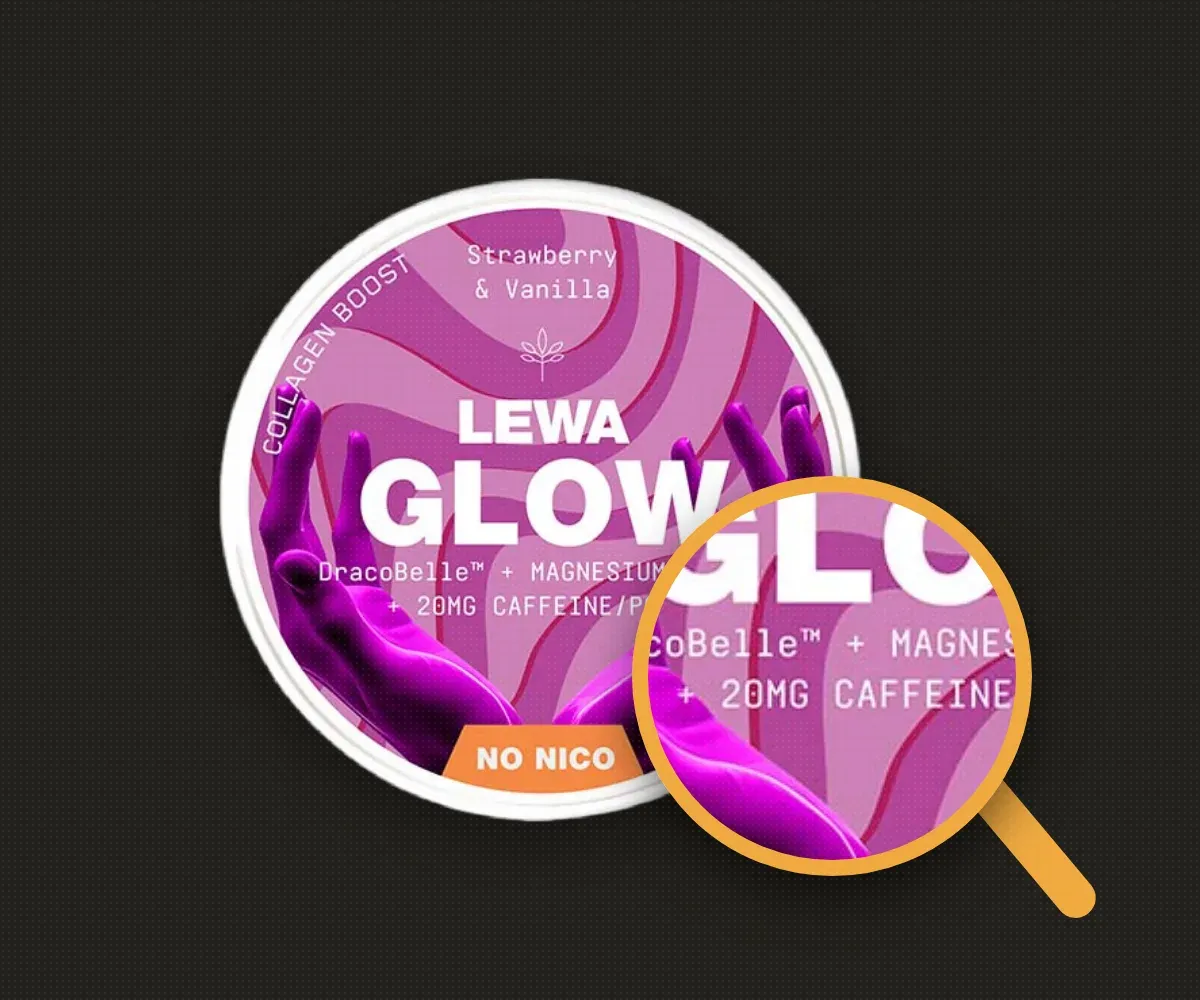
What is in a caffeine pouch
The 16 caffeine pouches in the nicotine-free range come from four manufacturers: LEWA Of Sweden (LEWA), LUNA Corporate (CAFERO), UAB Global Snus (CAMO) and Microzero (Hicaff). Their ingredient lists are short and overlap considerably.
Ingredient category: Plant fibre What it is: Microcrystalline cellulose, E460. The bulk material that gives the pouch its shape Where it appears on the panels: Every product in the range |
Ingredient category: Water What it is: Carries flavour and caffeine through the fibre Where it appears on the panels: Every product |
Ingredient category: Caffeine What it is: The active ingredient. A stimulant, listed in mg per pouch Where it appears on the panels: Every product: 20, 50, 77, 80 or 100 mg per pouch |
Ingredient category: Flavourings What it is: Mint, citrus, coffee, cola, fruit, liquorice and vanilla notes Where it appears on the panels: Every product |
Ingredient category: Sweeteners What it is: Sucralose (E955), acesulfame K (E950), stevia (E960), xylitol (E967), erythritol (E968), glycyrrhizin (E958) Where it appears on the panels: Every product; which ones varies by brand |
Ingredient category: Humectants What it is: Propylene glycol (E1520) or glycerol (E422). Keep the pouch moist Where it appears on the panels: Every product |
Ingredient category: Salt and pH regulators What it is: Sodium chloride; sodium carbonate (E500), potassium carbonate (E501), ammonium chloride (E510) Where it appears on the panels: Every product |
Ingredient category: Thickener and preservative What it is: Sodium alginate (E401) on Hicaff; potassium sorbate (E202) on CAFERO Where it appears on the panels: Hicaff, CAFERO |
Ingredient category: Vitamins, minerals and extracts What it is: Magnesium, zinc, selenium, vitamins B1, B2, B5 and B12, taurine, and ingredients listed under trade names (magtein, dracobelle, metabolaid) Where it appears on the panels: LEWA BURN, FOCUS, GLOW and POWER only |
Two things are on none of the 16 lists. None of them names nicotine; every product in the range is nicotine-free, 0 mg. None of them names tobacco. Sugar is not on any list either; the sweetness comes from the sweeteners in the table.
The E-numbers are the same regulatory shorthand found on food packaging. E460 is cellulose, the fibre the pouch is made of. E955 is sucralose. E500 is sodium carbonate, which sets the pH of the pouch. None of them is specific to pouches.
How much caffeine is in one pouch
The caffeine figure on the can is per pouch, not per can. The products on 24Nico sit at five levels.
Product: LEWA BURN Citrus Mint Caffeine per pouch: 20 mg Pouches per can: 18 Format and pouch weight: Slim, 0.6 g Flavour: Citrus and mint |
Product: LEWA FOCUS Cucumber Mint Caffeine per pouch: 20 mg Pouches per can: 18 Format and pouch weight: Slim, 0.6 g Flavour: Cucumber and mint |
Product: LEWA GLOW Strawberry Vanilla Caffeine per pouch: 20 mg Pouches per can: 18 Format and pouch weight: Slim, 0.6 g Flavour: Strawberry and vanilla |
Product: LEWA POWER Liquorice Raspberries, Cola Lime, Apple Spruce, Functional Wintermint Caffeine per pouch: 50 mg Pouches per can: 18 Format and pouch weight: Slim, 0.6 g Flavour: Liquorice and raspberry, cola and lime, apple and spruce, wintermint |
Product: CAMO Bubble Gum, Vanilla Coffee, Iced Mocha Caffeine Caffeine per pouch: 77 mg Pouches per can: 20 Format and pouch weight: Slim, 0.75 g Flavour: Bubble gum, vanilla coffee, coffee and chocolate |
Product: CAFERO Americano, Cappuccino, Vanilla Latte Caffeine per pouch: 80 mg Pouches per can: 20 Format and pouch weight: Slim, 0.65 g Flavour: Coffee |
Product: Hicaff Classic Cola, Energy Rush, Fresh Mint Slim Caffeine per pouch: 100 mg Pouches per can: 20 Format and pouch weight: Slim, 0.7 g Flavour: Cola, energy drink and menthol, mint |
Serving: One LEWA BURN, FOCUS or GLOW pouch Caffeine: 20 mg Source: Manufacturer's label |
Serving: One LEWA POWER pouch Caffeine: 50 mg Source: Manufacturer's label |
Serving: One CAMO Caffeine pouch Caffeine: 77 mg Source: Manufacturer's label |
Serving: One CAFERO pouch Caffeine: 80 mg Source: Manufacturer's label |
Serving: One Hicaff pouch Caffeine: 100 mg Source: Manufacturer's label |
Serving: Brewed coffee, 8 oz (about 240 ml) cup Caffeine: About 95 mg Source: USDA FoodData Central |
Serving: Red Bull, 250 ml can Caffeine: 80 mg Source: Manufacturer |
A 100 mg Hicaff pouch carries slightly more caffeine than the 8 oz (about 240 ml) cup of brewed coffee that USDA FoodData Central lists at about 95 mg. A CAFERO pouch and a 250 ml can of Red Bull carry the same figure, 80 mg, according to their manufacturers. A 20 mg LEWA pouch carries about a fifth of the coffee cup.
The comparison is of caffeine content only. A pouch is not a drink. It contains no liquid, lists no sugar, and is kept under the lip rather than swallowed. The coffee figure is an average for brewed coffee; a cup from a café can be well above or below it.
What public bodies say about caffeine intake
Several public bodies publish reference figures for caffeine.
Source: EFSA (European Food Safety Authority), 2015 scientific opinion on caffeine Reference figure: 400 mg a day; 200 mg in a single serving Who it refers to: Healthy adults |
Source: FDA (US Food and Drug Administration), consumer guidance "Spilling the Beans" Reference figure: Up to 400 mg of caffeine a day is not generally associated with negative effects Who it refers to: Healthy adults |
Source: ACOG (American College of Obstetricians and Gynecologists) and the NHS (UK National Health Service) Reference figure: 200 mg a day Who it refers to: During pregnancy |
Source: AAP (American Academy of Pediatrics) Reference figure: Discourages caffeine Who it refers to: Children and adolescents |
The EFSA and FDA figures refer to caffeine from every source combined over a day: coffee, tea, soft drinks, energy drinks and pouches alike. They are reference intakes published by those bodies for the groups named. Caffeine is a stimulant; how you respond to it is individual.
Who the manufacturers exclude
The warning line on a caffeine pouch can is written by the manufacturer, and it is the manufacturer's statement of who the product is not for. The wording differs between LEWA, CAFERO, CAMO and Hicaff, so check the can.
The public bodies above single out pregnancy (ACOG and the NHS, 200 mg a day) and children and adolescents (the AAP, which discourages caffeine).
How caffeine pouches are classified
Caffeine pouches are generally sold under food rules, as foods or food supplements, with the exact classification depending on the country. What such rules expect on the can is an ingredients panel and a label that states the caffeine content. Rules differ between countries and can change, and this is a description of the general position, not legal advice.
24Nico ships worldwide from Sweden. All taxes and duties are included in the price you see, nothing extra on delivery. The delivery page has the details.
How to read the panel
- Find the caffeine figure and confirm it is per pouch. Every product on 24Nico prints it that way; the figure also appears on the product page.
- Count the pouches per can: 18 for LEWA, 20 for CAFERO, CAMO and Hicaff. The can total is not a serving; the per-pouch figure is the one the label is built around.
- Compare the ingredient list with the ingredients table above. Cellulose, water, caffeine, flavourings, sweeteners, a humectant, salt and a pH regulator is the typical list. LEWA adds vitamins, minerals and extracts.
- Look for the manufacturer's warning line. That is where the exclusions are written.
- Look for "nicotine-free" or 0 mg. All 16 products in the caffeine pouch category are nicotine-free and tobacco-free.
The ingredients panel on each can is the source of truth.
Nicotine pouches come with their own set of effects, covered in nicotine pouches: side effects and what to expect.
FAQ
How much caffeine is in one caffeine pouch?
Between 20 mg and 100 mg per pouch, depending on the product. LEWA BURN, FOCUS and GLOW are 20 mg, LEWA POWER is 50 mg, CAMO is 77 mg, CAFERO is 80 mg and Hicaff is 100 mg per pouch, as printed by each manufacturer.
Is a caffeine pouch stronger than a cup of coffee?
It depends on the pouch. USDA FoodData Central lists brewed coffee at about 95 mg per 8 oz (about 240 ml) cup; a Hicaff pouch is 100 mg, a CAFERO pouch is 80 mg and a LEWA BURN pouch is 20 mg.
Do caffeine pouches contain nicotine or tobacco?
No. Every caffeine pouch on 24Nico is nicotine-free (0 mg) and tobacco-free; the base is plant fibre with caffeine, flavourings and sweeteners added.
What do EFSA and the FDA say about caffeine intake?
EFSA's 2015 opinion gives 400 mg a day and 200 mg in a single serving for healthy adults, and the FDA's consumer guidance states that up to 400 mg a day is not generally associated with negative effects for healthy adults. Both figures cover caffeine from all sources combined.
What is the reference figure during pregnancy?
ACOG and the NHS give 200 mg of caffeine a day during pregnancy.
What do public bodies say about caffeine for children?
The AAP discourages caffeine for children and adolescents.