Free delivery over US$99
Nicotine pouches vs cigarettes: how they actually compare
Nicotine pouches and cigarettes are often spoken about in the same breath because both contain nicotine. Almost everything else about them is different: format, ingredients, how nicotine reaches your body, where you can use each, and how each is regulated in the UK.
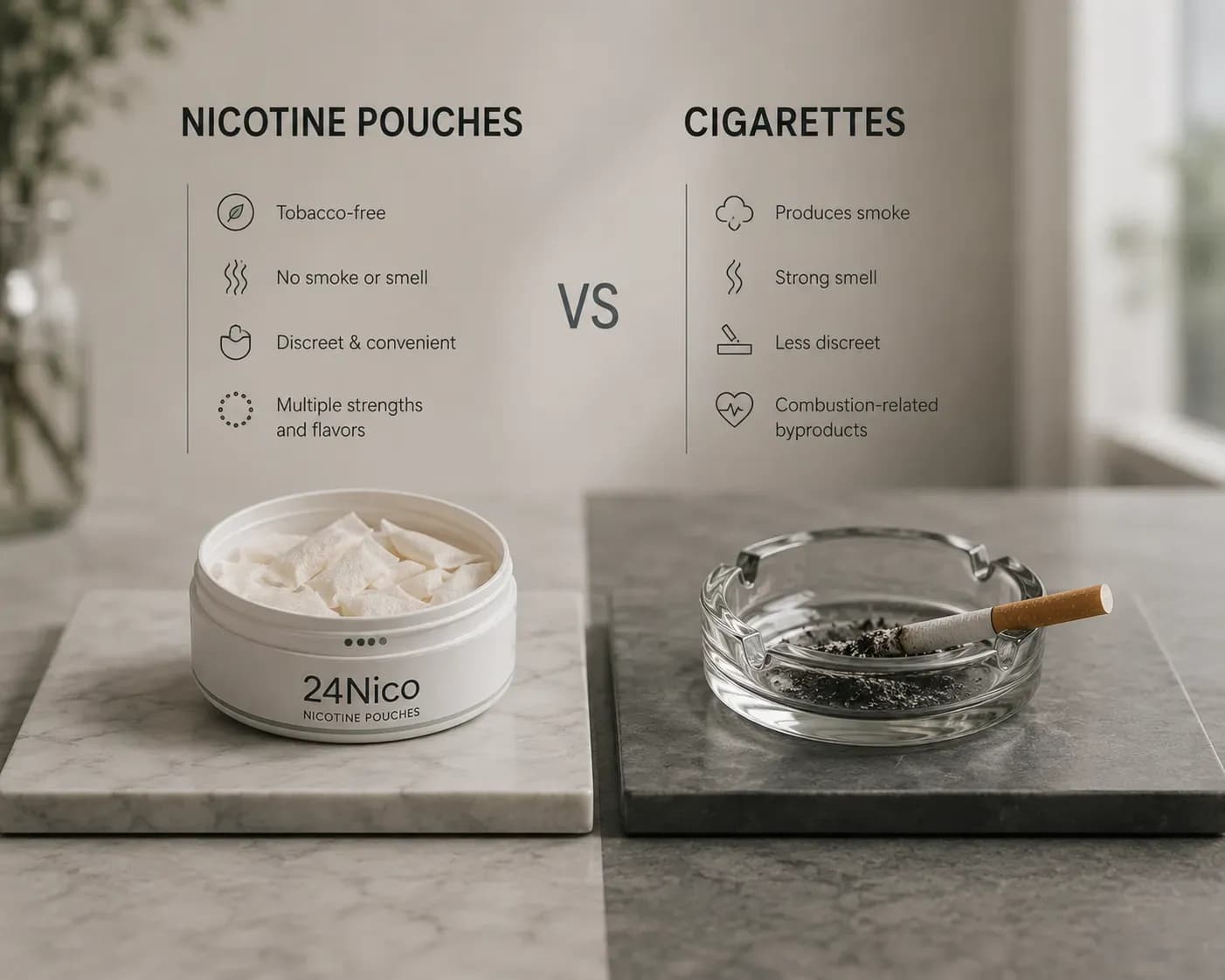
The short answer: how they're different
A cigarette is a tobacco product. Dried tobacco is rolled in paper, lit, and the smoke is inhaled into the lungs. Cancer Research UK puts the number of different chemicals in tobacco smoke at over 5,000, of which at least 70 are known to cause cancer.
A nicotine pouch is a tobacco-free product. A small pouch is placed under the upper lip. Saliva activates the contents, and nicotine is absorbed through the gum lining over 15 to 30 minutes. Nothing is burned, nothing is inhaled, and there is no tobacco in the pouch.
The two share one ingredient (nicotine) and almost nothing else.
Side by side
Cigarettes: Rolled tobacco in paper, lit and smoked Nicotine pouches: Small pouch placed under the upper lip |
Cigarettes: Yes Nicotine pouches: None |
Cigarettes: Yes Nicotine pouches: None |
Cigarettes: Inhaled as smoke into the lungs Nicotine pouches: Absorbed through the gum from saliva |
Cigarettes: Within seconds of inhalation Nicotine pouches: Gradual, noticeable within 5 to 10 minutes |
Cigarettes: A few minutes per cigarette Nicotine pouches: 15 to 30 minutes per pouch |
Cigarettes: Smoke, smell, ash Nicotine pouches: No smoke, no smell, no sound |
Cigarettes: Generational sales ban under the Tobacco and Vapes Act 2026; existing tobacco display, packaging and tax rules Nicotine pouches: Tobacco-free consumer product; 18+; advertising and packaging powers under the Tobacco and Vapes Act 2026 |
Cigarettes: Not a medicine Nicotine pouches: Not a medicine, not licensed as NRT |
What's in each
A cigarette contains processed tobacco, paper, and a filter. When it's lit, combustion produces smoke that carries nicotine alongside tar, carbon monoxide and thousands of other compounds.
A nicotine pouch sold in the UK typically contains:
- Plant-based fibres (typically microcrystalline cellulose, sometimes alongside eucalyptus pulp) as the bulk
- Purified nicotine, either extracted from tobacco and refined or made synthetically
- Flavouring (mint, fruit, coffee, etc.)
- pH regulators (e.g. sodium carbonate or sodium bicarbonate) to control nicotine release
- A small amount of sweetener and humectant
There is no tobacco leaf, no combustion residue, and nothing that needs to be heated or inhaled. For a full ingredient breakdown, see our nicotine pouches ingredients article.
How nicotine reaches your body
The two products deliver nicotine through different routes.
Cigarettes deliver nicotine through the lungs. When smoke is inhaled, nicotine crosses from the lungs into the bloodstream within seconds. The onset is fast and pronounced, and the dose is shaped by how deeply and how often you inhale.
Nicotine pouches deliver nicotine through the mouth. Saliva activates the pouch contents, and nicotine is absorbed through the gum lining over 15 to 30 minutes. The onset is gradual, usually noticeable within 5 to 10 minutes, and the release continues steadily for the duration of the pouch.
The two delivery curves are very different, and the felt experience is different too. A higher-milligram pouch is stronger than a lower-milligram one, but pouches do not replicate the pharmacokinetics of a cigarette.
How does a pouch's nicotine compare to a cigarette's?
One of the most common questions UK shoppers ask is how many cigarettes a 3 mg or 6 mg nicotine pouch is "equal to". Direct equivalence is misleading, because the two products deliver nicotine very differently.
A typical cigarette contains 10 to 12 mg of nicotine in the tobacco, but only about 1 to 2 mg of that nicotine is actually absorbed into the bloodstream per cigarette. Most is burned off or lost in sidestream smoke. The absorbed dose lands in the bloodstream within seconds of inhalation.
A nicotine pouch is labelled by total nicotine content per pouch, from around 3 mg in the lowest tier up to 50 mg or more in the strongest Ultra products. Not all of that nicotine is absorbed either: bioavailability through the gum is partial, and the release happens over 15 to 30 minutes rather than instantly. The proportion absorbed varies by brand, pouch pH, and how long you keep the pouch in.
So a 3 mg pouch and a single cigarette can deliver broadly comparable systemic doses on paper, but the experience is different: a cigarette delivers its dose in seconds, a pouch over half an hour. Comparing on label number alone misses the timing, which is the part most users actually feel.
If you're new to pouches and used to cigarettes, the strength tier that suits you is rarely the highest one. Our strength guide covers the Low, Normal, Strong, Xstrong and Ultra tiers and where most users start.
Format, smell and where you can use each
A cigarette produces smoke, ash and a strong smell that lingers on hair, clothes and indoor surfaces. UK rules and venue policy restrict where you can smoke:
- Smoking is banned in all enclosed workplaces and public places in England, Scotland, Wales and Northern Ireland.
- Smoking is banned on public transport, including buses, trains and the Underground.
- Smoking is banned in cars carrying anyone under 18.
- Many pub gardens, station forecourts and hospital grounds operate their own no-smoking policies.
A nicotine pouch produces no smoke, no smell, no vapour and no sound. Once it's under the upper lip, nobody can see it's there. There is no UK smoke-free legislation that covers nicotine pouches because there's nothing to inhale and nothing to second-hand expose anyone to. Individual venues set their own rules.
UK regulation in 2026
Cigarettes and nicotine pouches are regulated very differently in the UK.
Cigarettes fall under the existing UK tobacco regime: standardised packaging, point-of-display restrictions, advertising bans, and the highest excise duty on any consumer product. From 1 January 2009 onwards, the Tobacco and Vapes Act 2026 introduces a generational sales ban: it is now illegal to sell tobacco to anyone born on or after that date. Royal Assent was on 29 April 2026.
Nicotine pouches are tobacco-free consumer products. They are not regulated as medicines and are not licensed by the MHRA as nicotine replacement therapy (NRT). The UK government's Committee on Toxicity confirmed in its 2022 statement that "oral nicotine pouches are tobacco-free products… and as no medicinal claims are made they are also not regulated as medicines." Pouches sit in general consumer-product law, with additional advertising, sponsorship and packaging restrictions added under the Tobacco and Vapes Act 2026 (which covers "vapes and nicotine products" together as a category).
If you're asking about nicotine pouches in the context of stopping smoking, the route to look at is MHRA-licensed NRT: patches, gum, lozenges, inhalators, mouth sprays and nasal sprays from brands such as Nicorette, Nicotinell and NiQuitin, plus prescription medicines like varenicline. The NHS Stop Smoking Service is the official UK starting point.
For full guidance on the law affecting pouches, see our Are nicotine pouches legal in the UK? article.
Who buys nicotine pouches in the UK?
UK adult shoppers come to nicotine pouches from a few different starting points. Some have used Swedish snus or other oral nicotine formats for years. Some come from vaping and want a format with no kit and no vapour. Some are existing smokers exploring a tobacco-free format. A smaller number are entirely new to nicotine.
What pouches are not is a one-size-fits-all swap for a cigarette. The mechanism, onset, session length and feel are different, and not every cigarette user finds pouches to be the right format. The strength tier and format that suits you usually takes a couple of cans to settle.
If you're new to pouches, our nicotine pouches for beginners and strength guide articles are the right starting points.
FAQ
What's the main difference between nicotine pouches and cigarettes?
Cigarettes are a tobacco product that you light and inhale; nicotine pouches are tobacco-free products you place under your upper lip. They share one ingredient (nicotine) and almost nothing else: format, contents, delivery mechanism and UK regulation are all different.
Are nicotine pouches an NRT?
No. NRT (nicotine replacement therapy) is a category of MHRA-licensed medicinal products for smoking cessation, including patches, gum, lozenges, inhalators, mouth sprays and nasal sprays. Nicotine pouches are not licensed as medicines and are not part of the NRT category. Ask a pharmacist for a licensed NRT or visit the NHS Stop Smoking Service for cessation support.
Are nicotine pouches a way to quit smoking?
Nicotine pouches are not licensed by the MHRA as a smoking-cessation product. The official UK route is the NHS Stop Smoking Service, which can recommend licensed NRT, prescription medicines like varenicline, and behavioural support.
Can you use nicotine pouches and cigarettes at the same time?
Some adult users do. There is no UK rule against it, but if your goal is to stop smoking, the NHS Stop Smoking Service can talk you through the recommended steps.
Do nicotine pouches contain tar or carbon monoxide?
No. Both are products of combustion. Nicotine pouches aren't lit and don't produce smoke, so they don't contain tar or carbon monoxide.
Are nicotine pouches cheaper than cigarettes?
On average, yes, but the comparison depends on usage. A 20-pack of cigarettes in the UK costs around £16 to £17 in 2026, so a pack-a-day smoker spends roughly £500 a month. A typical can of 20 nicotine pouches costs around £3 to £6, with multi-can deals lower; a one-can-a-day user spends around £100 to £180 a month. Whether the maths works for any individual depends entirely on how many of each they use.
Are nicotine pouches legal in the UK?
Yes, for adults aged 18 and over, subject to the Tobacco and Vapes Act 2026 advertising and packaging rules. See our Are nicotine pouches legal in the UK? article.