Free delivery over USD 99
Nicotine pouches vs vaping: how they actually compare
Nicotine pouches and vapes are often discussed in the same breath because both are tobacco-free and both deliver nicotine without smoke. But they work very differently - different mechanism, different feel, different rules, different costs.
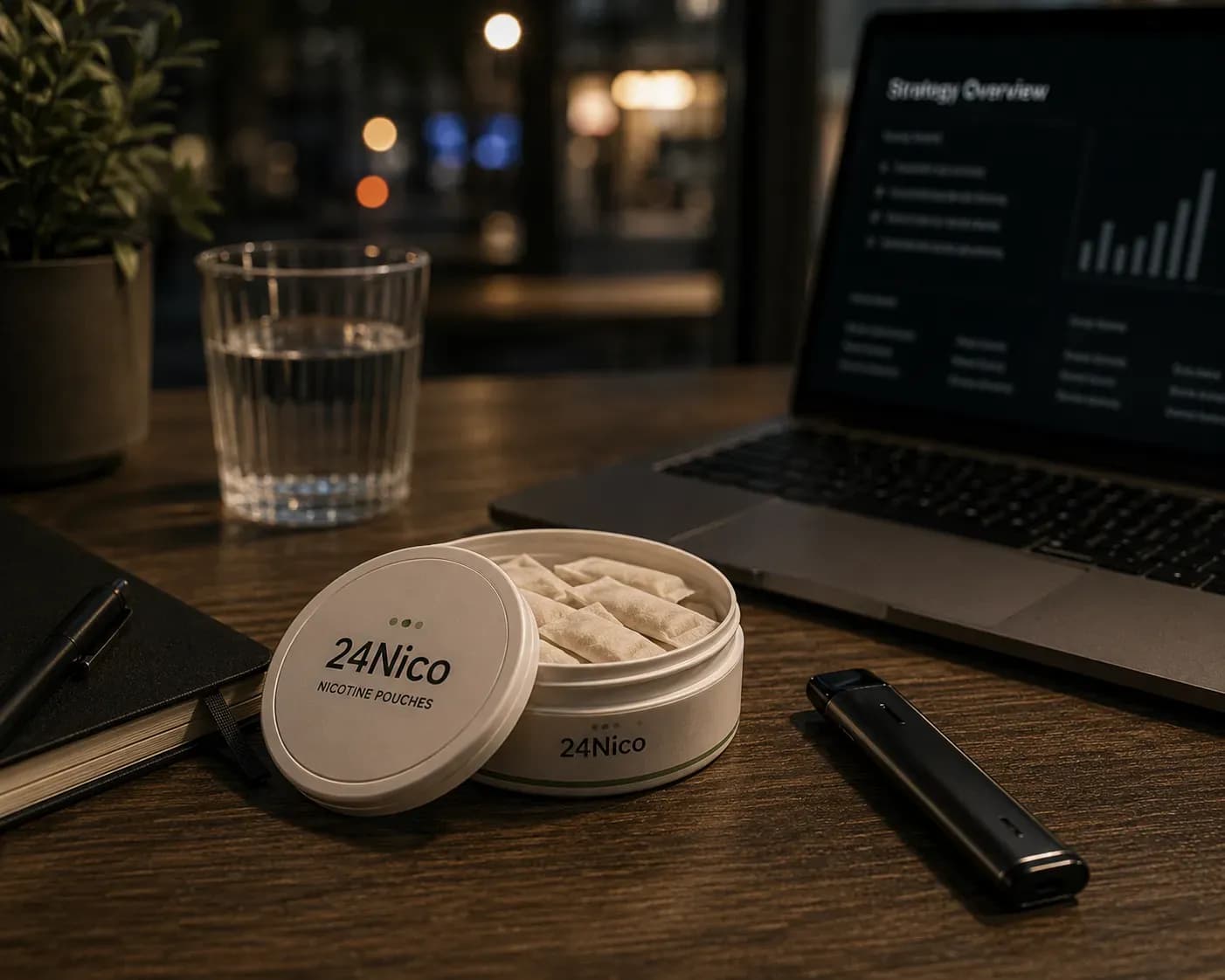
The short answer: how they're different
Nicotine pouches and vapes both deliver nicotine without tobacco, but the mechanism is opposite ends of a spectrum: pouches sit under your upper lip and release nicotine through the gum (slow, discreet, no kit); vapes use a battery-powered device that heats liquid into an inhaled vapour - the cloud you exhale, often called "vape smoke."
Side by side
Nicotine pouches: Small pouch placed under the upper lip Vaping: Battery-powered device with refillable or pre-filled liquid |
Nicotine pouches: None Vaping: None |
Nicotine pouches: Absorbed through the gum from saliva Vaping: Inhaled as vapour into the lungs |
Nicotine pouches: Gradual - noticeable within 5–10 minutes Vaping: Fast - within seconds of inhalation |
Nicotine pouches: 15–30 minutes per pouch Vaping: Variable - a few puffs to a long session |
Nicotine pouches: No vapour, no smell, no sound Vaping: Vapour cloud, often a sweet smell, button click |
Nicotine pouches: None - open the can Vaping: Device, charger, replacement pods or e-liquid |
Nicotine pouches: Anywhere - fully discreet Vaping: Restricted in many indoor and public spaces |
Nicotine pouches: Tobacco-free consumer product; 18+; Tobacco and Vapes Act 2026 advertising rules Vaping: Tobacco-free consumer product; 18+; UK disposable-vape restrictions; advertising rules |
Nicotine pouches: Used pouches in general waste; cans often recyclable Vaping: Devices and batteries require specific battery/electrical disposal points |
How the nicotine kick differs
The mechanism difference is the biggest practical thing to understand.
With a vape, nicotine reaches your bloodstream through the lungs within seconds of inhaling. The effect is fast and pronounced, and you can control it puff by puff - small puffs for a small amount, longer puffs for more. The trade-off is that the fast onset can feel intense for someone who isn't used to it.
With a nicotine pouch, nicotine is absorbed gradually through the lining of your mouth as your saliva activates the contents. The onset is slower - you usually notice it within 5 to 10 minutes - and the release continues steadily for around 15 to 30 minutes. Once the pouch is in place, the effect builds and tapers off without any further input from you.
In practice, that means:
- Vapes give you immediate control. You decide moment to moment how much to inhale.
- Pouches give you a steady release. You don't think about it once it's under your lip.
Some users prefer the on-demand control of a vape; others prefer the set-and-forget rhythm of a pouch. Neither is universally "better".
Discretion and where you can use each
This is often the deciding factor for everyday use.
A nicotine pouch is invisible. There's no vapour, no smell, no sound, and once it's under your lip nobody can see it's there. You can use one in a meeting, on a flight, in a cinema, in someone's living room, or at the gym - settings where vaping isn't on the table.
A vape is a visible product with a vapour cloud and often a noticeable smell. UK rules and venue policy restrict where you can use it:
- Workplaces typically follow their own vaping policies, which are usually similar to smoking policies.
- Public transport (buses, trains, the Underground) prohibits vaping.
- Pubs, restaurants, cafes vary by venue but most do not allow indoor vaping.
- Aircraft cabins prohibit vaping; vape devices must travel in hand luggage and not be charged in flight.
If discretion in a meeting room or on a long flight matters to you, that's a clear point in favour of pouches. If you mainly use nicotine at home or in venues where vaping is allowed, the discretion difference matters less.
UK regulation in 2026
Both are legal tobacco-free products in the UK for adults aged 18 and over, but the regulatory pictures differ - and both are changing.
The Tobacco and Vapes Act 2026 received Royal Assent on 29 April 2026. It tightens advertising and promotion rules for nicotine products generally, age-verification requirements for online sales, and packaging standards. It applies to both pouches and vapes, but with different specific provisions.
For vapes specifically, the UK has additionally restricted disposable vapes. The sale and supply of single-use disposable vapes became illegal across the UK on 1 June 2025 - a separate measure that came into force ahead of the wider Tobacco and Vapes Act. Refillable devices and reusable pod systems remain available, but the disposable-vape segment is no longer legal to sell.
For nicotine pouches, there's no equivalent product-level restriction yet, but the Act does give the government powers to set further product-standards rules in future secondary legislation. The direction of travel is more regulation, not less.
Practical implications for an everyday UK user:
- Both products require ID verification on purchase and online.
- Both are restricted in advertising - you'll see fewer adverts for either over the next 12 months.
- Vapes have additional product-level restrictions already in force.
- Pouches don't, but may have new rules added in the next 12–24 months.
For full guidance on the law, see our Are nicotine pouches legal in the UK? article.
Cost over time
Both can fit different budgets, but the cost shapes are very different.
Vapes flip that shape: bigger upfront, smaller per-session. A reusable pod or starter kit runs £10–£30, replacement pods are a few pounds each, and a 10ml bottle of nic-salt e-liquid sits around £2–£4 individually (or roughly £1.70 in multi-bottle deals). Most regular vapers spend £15–£40 a month on consumables.
Pouches have no upfront cost and a steady per-can cost. A typical 20-pouch can sits around £4 at UK retailers, with most brands in the £3–£6 range. At £4 a can, one a day works out to ~£120 a month, three a week to ~£52, and one a week to ~£17. Multi-can deals knock another 10–20% off.
Comparing roughly:
- Light to moderate use: pouches and vapes land in a similar monthly band.
- Heavy use: vapes are usually cheaper per session, pouches usually more predictable.
- Travel and setup hassle: vapes have it, pouches don't.
Prices change. The figures here are general 2026 ranges - for live pricing on what 24Nico stocks, browse the nicotine pouches range.
Which one suits which kind of user?
Two products, two slightly different shapes of user.
A vape suits you better if:
- You want fast, on-demand nicotine delivery you can control puff by puff.
- You enjoy the ritual of the device itself.
- Most of your use happens at home or in vape-friendly venues.
- You're already familiar with handling kit, charging, and refilling.
A nicotine pouch suits you better if:
- You want nicotine without vapour, smell or visible product.
- You move through environments where vaping isn't appropriate (offices, public transport, flights).
- You'd rather not carry kit or worry about a battery.
- You prefer a steady release to puff-by-puff control.
A reasonable number of UK users go through both depending on the day - pouches for work and travel, vapes at home. They're not mutually exclusive products.
If the question is the pouch itself rather than vaping, caffeine pouches vs nicotine pouches compares the two pouch types.
FAQ
Are nicotine pouches better than vaping?
"Better" depends entirely on what you're optimising for. Pouches are more discreet, lower-kit and steady. Vapes are faster-acting and more controllable session-by-session. Neither is positioned as a stop-smoking aid, and neither is universally "better" than the other.
Is one stronger than the other?
Both come in a range of strengths. Pouches are labelled in mg per pouch (typically 4 mg to 20 mg+), vapes in mg/ml of nicotine (typically 3 to 20 mg/ml in the UK). The "felt" strength depends on dose and how you use the product, not just the label number.
Can you use both?
Yes. There's no rule against using both, and a number of UK users do - pouches in environments where vaping isn't appropriate, vapes at home. Watch your total daily nicotine if you do.
Are nicotine pouches an alternative to vaping?
They're a different product category, so "alternative" depends on what you mean. If you want a nicotine product without vapour and kit, pouches do that. If you want fast on-demand delivery, vapes do that. They serve overlapping but not identical needs.
Are pouches or vapes more legal in the UK?
Both are legal for adults aged 18 and over. Vapes have more specific product-level restrictions in 2026 (notably the disposable-vape restriction). Pouches don't yet, but the Tobacco and Vapes Act 2026 gives the government powers to add further rules.
Can I take pouches and vapes on a plane?
Pouches yes, in hand or hold luggage on UK airlines. Vapes yes, in hand luggage only - they cannot be packed in hold luggage and cannot be charged or used during the flight. Destination rules vary; check before travelling.
Which is cheaper?
For light-to-moderate use, the monthly cost is similar. For heavy use, vapes can be cheaper per session, pouches more predictable. Both depend heavily on brand and strength.
Are nicotine pouches a way to quit smoking?
No. Nicotine pouches are not licensed by the MHRA as a nicotine replacement therapy. The NHS Stop Smoking Service is the official UK starting point if you want to quit smoking.